A Shared Meal When Everyone Arrives at a Different Time
A shared meal with staggered arrivals can feel relaxed: set a clear arrival window, make the welcome obvious, and let guests join without interrupting the table.
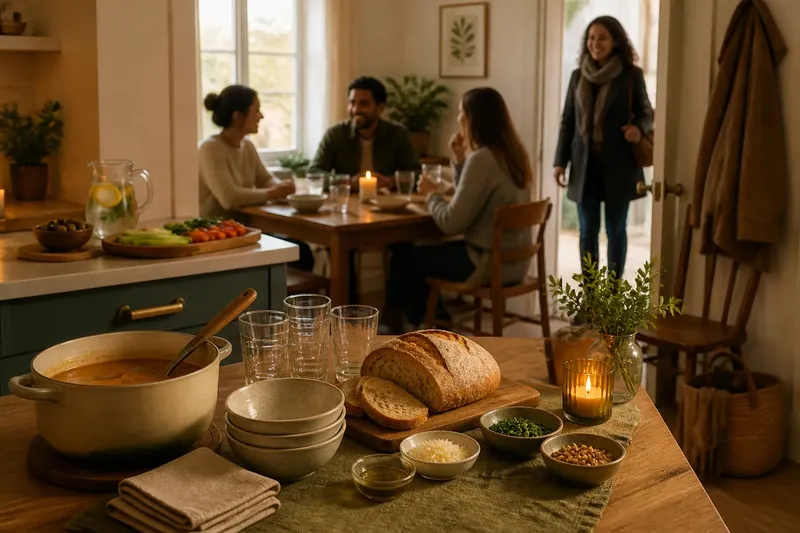
At six o’clock, Maya has soup warming, bread on a board, and a message from her friend saying the train is delayed. Two other guests are expected later, and one can stay only briefly. She had planned a single sit-down dinner, but that makes each arrival feel like a disruption. A shared meal with staggered arrivals works better when guests know when to come and how to join in.
Imagine this invented situation: Maya is hosting a casual evening for four friends. One expects to arrive near the start, another has an uncertain commute, and the last can come only after an errand. Maya wants people to eat together if their schedules overlap, without asking anyone to apologize for being late or making the first guest wait hungry. She decides the gathering will run from six to eight, with food available throughout, and sends that plan to everyone.
How do you set a flexible arrival window?
Give guests a clear window rather than one exact start time or an open-ended invitation. Maya writes: “Come between six and seven-thirty; soup and bread will be ready when you arrive. I’ll wrap up around eight.” The window tells guests when they can show up, while the end time gives the evening a boundary.
She does not promise that everyone will be present at once. Maya can start eating with whoever arrives first. If the group overlaps later, they can share another serving or sit together for dessert.
Choose a window that fits the actual evening. If the gathering needs to end at a particular time, say so plainly. If the main dish cannot wait comfortably, offer a forgiving first bite—such as olives, sliced vegetables, or crackers—while saving the main course for a time that suits it.
How can guests tell where to begin?
Make the welcome visible before anyone has to ask. Maya puts a small plate, napkins, glasses, and bread near the kitchen entrance, with the soup pot and bowls on the counter. She tells guests, “Coats go on the chair by the door; help yourself to bread and a drink.” That gives people a simple path from arrival to settling in.
Put self-serve items together, keep the walkway clear, and leave a spot for bags away from the food. If guests may arrive while Maya is answering the door or finishing a task, the setup still gives them something easy to do. A pitcher of water or a tray of snacks can signal that the gathering is underway.
Think of the welcome like a doormat: it marks the transition without requiring a speech. Keep it easy to notice and use. The more obvious the first move, the less the host needs to monitor each arrival.
What food works when guests arrive at different times?
For Maya’s invented evening, soup, bread, and toppings suit the staggered timing because people can serve themselves in separate portions. She keeps the soup warm and sets out grated cheese and chopped herbs in small bowls. Guests can eat promptly, take a modest portion, or wait until someone else joins without coordinating a precise serving moment.
Other useful choices include baked pasta served in portions, bean salad, roasted vegetables, or bread with spreads. The goal is not an elaborate buffet. Choose food that allows a pause without sending the host back to the kitchen whenever the door opens.
Keep the menu manageable: one main dish, one simple accompaniment, and something easy to nibble are often plenty. Put serving spoons where they belong and keep extra bowls or plates within reach. If guests have dietary needs, ask in advance and label dishes plainly so they can choose without a public exchange at the table.
For food handling, follow package directions and ordinary food-safety guidance, especially for dishes that need temperature control. If an ingredient raises a health concern, check with the guest and consult a qualified professional when appropriate.
How can the group reconnect without an announcement?
Staggered arrivals can split a gathering into separate conversations: early guests have one thread, late guests enter another, and the host may feel caught between them. Maya does not stop the room for introductions. When a new friend arrives, she offers a quick bridge: “We were just talking about the garden beds—Sam has been trying tomatoes on the balcony.” Then she lets the conversation continue.
A low-pressure shared moment can help, too. Maya plans to put dessert on the table after the later guest arrives, but she does not hold the meal for that moment. If the group overlaps, dessert becomes a natural point to gather. If not, the first guests can have it earlier, and the latecomer can take a piece on arrival.
In Maya’s imagined evening, the result is straightforward: the first guest eats without waiting, the delayed friend can enter without apologizing, and the person with limited time gets a chance to sit and talk. Maya spends less of the evening checking the clock because the invitation has already made the timing clear.
What should you tell guests before they arrive?
Should the invitation include an end time?
Include one if the room, host, or guests need a clear stopping point. “Come between six and seven-thirty; we’ll wrap up around eight” is more useful than “come whenever,” while still allowing different arrival times.
Should late guests text when they are close?
Ask for a message only if it helps with a real choice, such as setting aside a portion or meeting someone at the door. Otherwise, let guests arrive without creating another obligation to report their progress.
What if someone arrives after everyone has eaten?
Say whether food will still be available or whether the gathering is mainly for conversation after a certain point. Setting aside a portion can be kind when it fits the menu, but it need not become a promise you cannot manage.
How can a guest with a short visit feel included?
Tell them what part of the evening is likely to be shared, such as the first drink, dessert, or a walk around the block. Give them a comfortable place to join rather than framing their shorter stay as a problem.
What can you carry into your next shared meal?
After the imagined gathering, Maya keeps the parts that reduced friction: a defined arrival window, a clear place for coats and drinks, and food that can be served in portions. A host does not need to stage a perfect moment when every chair is occupied. A meal can have several beginnings, each marked by someone arriving, sitting down, and being welcomed into what is already happening.
For your own shared meal with staggered arrivals, decide what can flex and what cannot. Set out food so guests can understand it, tell them how to join, and choose one natural point for everyone to come together if timing allows. That is enough structure to make the evening legible without turning it into a schedule guests must obey.
Send a short update if the plan changes in a way guests need to know, such as moving to another entrance or serving the main dish later than expected. Otherwise, a clear arrival window, an obvious welcome, and food that tolerates pauses give people room to arrive as they are.