Paper List or Calendar Block? Picking a Planning Surface
Paper list or calendar block? Choose a planning surface that fits your day, so flexible tasks stay visible and time-sensitive commitments have room.
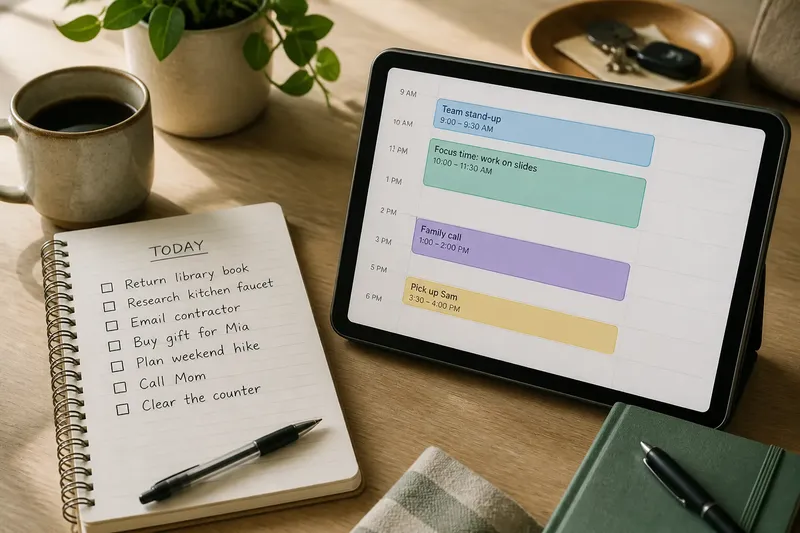
You have a grocery receipt, a half-finished task list, and a calendar alert competing for attention before lunch. Choosing between a paper list and a calendar block is easier when you ask what each decision needs: a place to remember a task, or a claim on a particular stretch of time.
A list holds intentions without assigning them a time. A calendar block reserves time for something that needs a start, a duration, or coordination with someone else. Neither surface is inherently more disciplined. They solve different problems, and a day may need both.
What does each planning surface promise?
A paper list is a queue of possible actions. You can add an item as it occurs to you, reorder it, cross it off, or carry it forward. Its main promise is visibility: the task stays somewhere you can see without pretending you know exactly when you will do it.
A calendar block is a time claim. It says, “I intend to use this part of the day for this activity.” A block can protect focused work, mark a trip across town, or show a colleague when you are available. It is more specific than a list item, so it is also more vulnerable to changes in the day.
Think of the list as a tray holding ingredients and the calendar as the counter space set aside for cooking. The tray keeps options together; the counter tells you when and where you will act. Confusing the two can make a flexible task feel like a missed appointment or leave a real commitment floating without a time.
When is a paper list the better fit?
Use a list when the task matters but its timing can move. Household errands, ideas to ask about, small repairs to research, and messages to send often belong here until you know when they fit. A handwritten page can be especially useful when you want a quick glance without opening an app or choosing a time slot.
Lists also suit days with uncertain demands. If you are waiting for a delivery window, helping a family member, or handling work that arrives unpredictably, a fixed schedule may create more friction than clarity. A short list lets you choose the next feasible task as the day unfolds.
Keep the wording actionable. “Kitchen” is hard to finish; “clear the counter” names a visible action. If an item contains several distinct tasks, split it only when that makes choosing the next move easier. A page should help you decide, not become an inventory of every thought you have had.
When should a task become a calendar block?
Put something on the calendar when its timing matters to you or to another person. Appointments, school pickup, a meeting, a commute, and a call across time zones need a time anchor. So can a task that requires uninterrupted attention or a particular resource, such as a quiet room.
Blocks are also useful when a task repeatedly gets crowded out. Reserving a period for drafting, paperwork, or meal preparation makes the intention visible beside the commitments that compete with it. Give the block a plain name and a realistic scope; “work on report” is clearer than a vague label such as “be productive.”
Not every item on a list deserves a block. If you schedule every small errand, routine choice, and passing idea, the calendar can become brittle. Leave some open space for transitions, delays, and tasks whose timing is still unknown. A calendar with no room to absorb a change is a poor description of a real day.
How can you choose between a list and a block?
Ask three questions before assigning a task a home:
- Does someone expect me at a particular time? Use a calendar entry, including travel or preparation time if those affect the commitment.
- Does this need a protected stretch of attention? Consider a block, especially if other obligations tend to displace it.
- Can I do it whenever a suitable opening appears? Keep it on a list until a real time constraint emerges.
Say you need to return a library book, prepare slides for a meeting, and attend a family call. The call has an agreed time, so it belongs on the calendar. The slide preparation may need a quiet stretch, so you could reserve a block for it. Returning the book can stay on a list until you know which trip will take you near the library.
This division avoids a common mismatch: treating all tasks as appointments or treating every commitment as a loose intention. It also keeps the list useful as a source of choices rather than a second, overcrowded calendar.
What if a day changes after you planned it?
When a block is disrupted, decide whether the task still needs protected time or can return to the list. Move only what still matters; do not automatically rebuild the whole day around one missed slot. If a fixed appointment changes, update the calendar so it remains a trustworthy record of your commitments.
For lists, carry forward deliberately. Mark what is still relevant, cross out what no longer matters, and rewrite an item if its next action has changed. Copying an entire page forward can make old intentions look urgent simply because they have been waiting.
Some people prefer a paper list beside a digital calendar. That is a workable pairing if each surface has a clear job: the calendar holds commitments and time-specific work, while the paper holds flexible actions. Avoid maintaining the same full task list in both places; duplicate copies can drift apart and make it unclear which one to trust.
Which planning surface fits your day best?
Should every task have a calendar block?
No. Use blocks for commitments and work that benefits from reserved time, while leaving movable tasks on a list. Scheduling every small action can leave too little room to respond to changes.
Can I use a paper list with a digital calendar?
Yes, if each tool has a distinct role. For example, keep appointments in the calendar and flexible errands on paper rather than copying the same items into both.
What should I do with a task that keeps moving?
Ask whether a specific time is truly necessary. If it is, choose a more realistic block; if not, return it to the list and decide when an opening appears.
How much detail belongs in a calendar block?
Include enough to recognize the commitment and prepare for it. A short label and any essential location or reminder are often more usable than a block packed with instructions.
How do you keep the system light?
Choose one place for fixed commitments and one place for flexible tasks, then review them together when deciding what the day can hold. The review can be brief: notice what is time-bound, choose a realistic task or two for open periods, and leave some room unassigned.
Paper list or calendar block is not a permanent identity choice. The useful surface depends on the shape of the day: a list supports selection, while a calendar makes timing visible. If a task changes from flexible to time-sensitive, move it; if its fixed slot no longer helps, let it become a list item again.
When you are unsure, write the task down first and assign a time only when the timing itself matters. That small distinction keeps planning practical: your list can hold what you might do, and your calendar can show what the day has agreed to hold.