The Quiet History of the Personal Diary
The history of the personal diary shows how notebooks can hold useful records and private reflection, while reminding readers to interpret old entries in context.
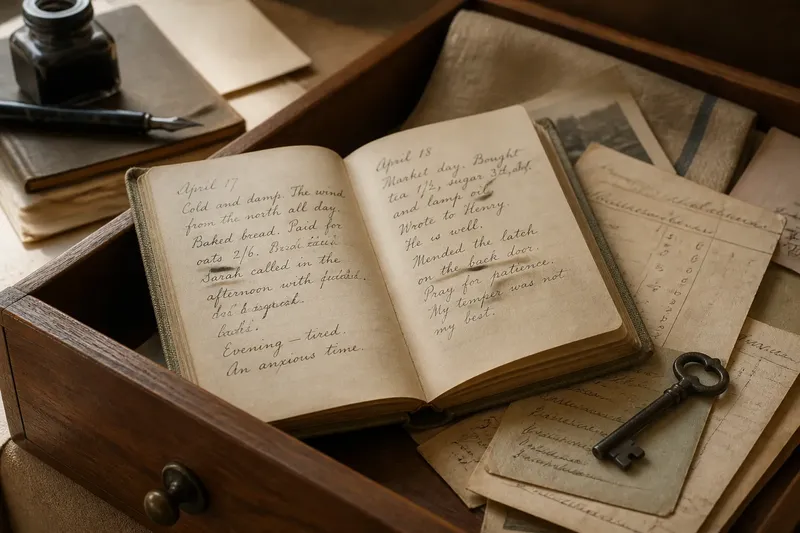
A drawer sticks, and a clothbound diary slides out beside old receipts and a spare key. Its pages hold weather notes, errands, family news, and a few lines about a difficult afternoon. The history of the personal diary is best approached through the pages people left behind, not as a single story about how everyone learned to write privately.
“Diary” can describe very different records: a ledger of household business, a dated account of events, a spiritual exercise, or a notebook kept for personal reflection. These forms can overlap. A writer might record a practical matter and a private worry on the same page, without treating the notebook as a confession.
What did early diaries record?
Surviving diaries and daybooks include accounts of work, travel, household affairs, religious observance, and public events. Their purposes varied with the writer and setting. Some entries helped someone remember or manage obligations; others preserved observations or reflected on conduct.
It is safer not to treat these records as representative of everyone’s daily life. Writing materials and literacy were not equally available, and many people’s words were never written down or preserved. A notebook that survives tells us something about its writer and the circumstances of its preservation, not a complete account of a whole society.
A record can still reveal personal details without having been written primarily for self-exploration. A household account might mention a visitor or a repair because the information mattered to the writer’s practical purpose. The notebook is like a labeled kitchen drawer: it can store useful odds and ends without being designed as a portrait of the person who keeps it.
How did personal reflection enter diary writing?
There is no single turning point when diaries became private. Different kinds of personal writing developed in different settings, shaped by access to paper, habits of reading and correspondence, religious practice, and the writer’s intended audience. Some people used writing to review their conduct or preserve family memories; others recorded journeys, decisions, or events they feared they might forget.
Privacy also depended on ordinary arrangements. A writer might have a desk, a place to store pages, or a household understanding about who could read them. A notebook was not automatically private simply because it was handwritten. The possibility of being discovered could affect what a person chose to record.
These distinctions matter when reading an old diary. A personal tone does not prove that the writer intended an entry only for themselves. Consider who the writer was, what the notebook was for, and whether the pages suggest an audience beyond the writer.
Why do diaries mix routine details with strong feelings?
A dated entry can hold whatever mattered at the time: a visitor, the weather, a task, a worry, or a passing thought. Routine details are not merely filler. They can show what occupied a person’s day, while a brief emotional note may explain why one ordinary event stayed in memory.
There is no universal rule that a diary must be written every day or contain an important revelation. Some records are intermittent, selective, practical, or guarded. A blank stretch says only that no entry survives there; it does not, by itself, explain why.
For a reader today, the useful question is not whether an entry seems profound. Ask what it was meant to preserve. A short note about a recurring errand may help explain the demands of a period, while a longer reflection may reveal only one moment’s perspective.
What questions help when reading a diary?
Was the diary meant for a private reader?
Look for clues in the language, format, and subject matter, but treat them as clues rather than proof. A writer could address themselves, a family member, or an imagined future reader, and the intended audience may remain uncertain.
Can one diary represent a whole community?
One diary records a particular person’s viewpoint and omissions. Use it to understand that account, then avoid treating it as a complete picture of people who did not write or whose records did not survive.
Why are some entries edited or incomplete?
A surviving notebook may have missing pages, later annotations, or an edited published version. Check whether you are reading the original record or a selection, and keep those limits in mind when interpreting details.
How should a painful old entry be read?
Read it as a record of what the writer knew or felt at that moment, not as a permanent judgment. If it becomes upsetting, stop and return only if doing so feels useful.
How can a private diary become a public record?
A diary can reach other readers if its writer shares it, relatives preserve it, or an editor prepares it for publication. Its meaning may then change: a note written to remember a day can also offer evidence about a household or a particular event.
Publication creates another layer between the original writer and the reader. An edition may select entries, add notes, or omit material. Even an unedited notebook reflects choices about what the writer recorded and what later owners kept. It is not a transparent window onto the past.
When using a diary as historical evidence, distinguish the entry from the interpretation built around it. Ask who wrote it, what they could have known, what they may have left out, and how the document reached its present form. Those questions help preserve the diary’s value without asking it to speak for everyone.
How can the history of the personal diary shape your own writing?
The history of the personal diary suggests no single correct format. A paper notebook, a dated file, or a voice memo can serve as a memory aid, a place to examine a decision, or a record of daily logistics. Choose the form that suits the purpose, and decide what should remain private before adding sensitive details.
Say you are preparing to leave a longtime home and the days are blurring together. You begin with three notes: the stairwell’s familiar echo, a neighbor’s offer to help carry boxes, and your decision to keep a chipped blue mug. You add them to a dated notebook after packing. Later, the result is a small record of sounds, connection, and choice—not a complete account of the move, but enough to distinguish those days from one another.
- If you want to remember events, check whether the date and sequence are clear; if they are, keep the entry as a record, and if not, add a brief time or context note.
- If you want to track a decision, check whether you have written the question and the reason for your choice; if both are present, leave it to revisit later, and if either is missing, add that detail.
- If an entry includes another person’s sensitive information, check whether it needs to be identifiable; if not, remove identifying details, and if it does, store the entry somewhere more private or leave that detail out.
- If you have skipped several days, check whether the record still serves its purpose; if it does, continue with the next useful entry, and if it does not, change the format or narrow the subject.
- If an old entry feels painful, check whether reading further is helping; if it is, continue at a pace that feels manageable, and if it is not, close the notebook and return another time—or not at all.
- If you may share an entry, check whether it contains details that could expose someone else; if it does, revise or withhold those details, and if it does not, decide whether sharing still fits your purpose.
A diary does not need to become a complete portrait of a life to be worth keeping. Start with the memory, question, or practical detail you want the page to hold, then let the record remain partial. That choice is part of what makes the personal diary useful across its different forms.