Why a Familiar Cue Helps a Routine Begin
A familiar cue can make a routine easier to begin without a full schedule. Choose a cue you already meet and pair it with one small action.

You set your mug beside the sink after breakfast, then remember the stretch you meant to do and keep walking. A familiar cue can help a routine begin by giving that small action a place in a moment you already recognize. It does not require a full schedule or a fixed morning plan.
The useful question is not how to organize every hour. It is which existing moment can quietly signal one manageable action. A cue might be closing your laptop, putting a key in its bowl, or starting the kettle. Compare a moment-based cue, a place-based cue, and an object-based cue, then choose the one you are most likely to notice in your actual day.
What makes a familiar cue useful?
A cue is an event you can notice without having to consult a plan. The action follows it: after you hang up your coat, you put your lunch container by the door; when you sit down at your desk, you open the page you need. The link is simple: “When this happens, I do that.”
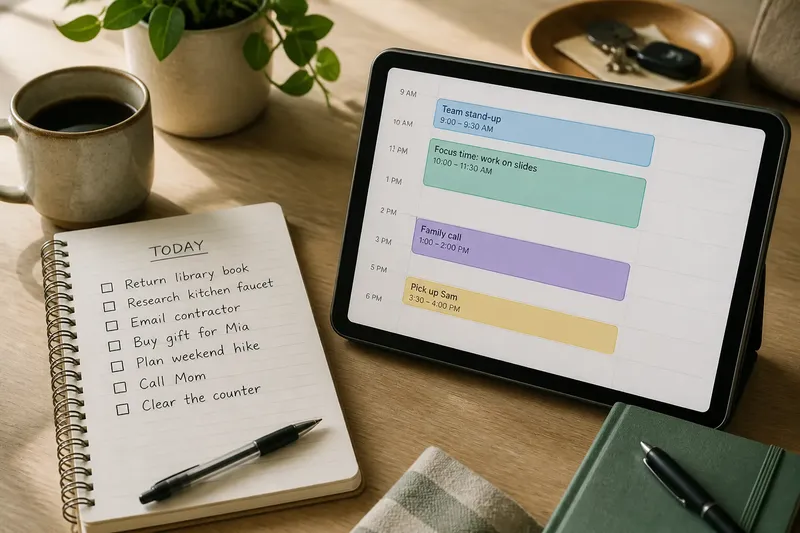
This differs from a schedule, which asks you to remember a time and make room for an activity. A cue instead borrows a moment that is already part of your day. It can make the start easier to see, but it cannot remove every obstacle or make an inconvenient action fit. Keep the action small enough to start even when your attention is elsewhere.
Think of the cue as a bookmark in a book. It marks where to pick up, but it does not read the page for you. If the cue is hard to notice, or the next action is too involved, the routine may still be easy to miss.
Should you attach the action to a moment, place, or object?
Each approach uses a different kind of reminder. Choose by looking at what is stable in your day, rather than what sounds most disciplined.
Moment-based cues
A moment-based cue is an event that tends to happen before the action: after lunch, when you close a work call, or once you take off your shoes. It is often a good fit when your day has a few dependable transitions but no dependable timetable.
For example, “after I close my laptop for the day, I’ll put the book I want to read on the sofa” ties preparation to a clear ending. But if you close your laptop at different times, the cue still works only if you notice that closing action. Choose a transition that happens reliably enough and is not already followed by an urgent demand.
Place-based cues
A place-based cue uses arrival or departure: when you enter the kitchen, you fill a glass of water; when you sit in your favorite chair, you take out your knitting. It suits actions that belong naturally in a particular room or spot.
Places can be less dependable if you move between work locations, share a room, or use the same area for several purposes. In that case, specify the moment as well as the place—such as sitting at the desk after lunch—so merely passing through the room does not have to serve as the reminder.
Object-based cues
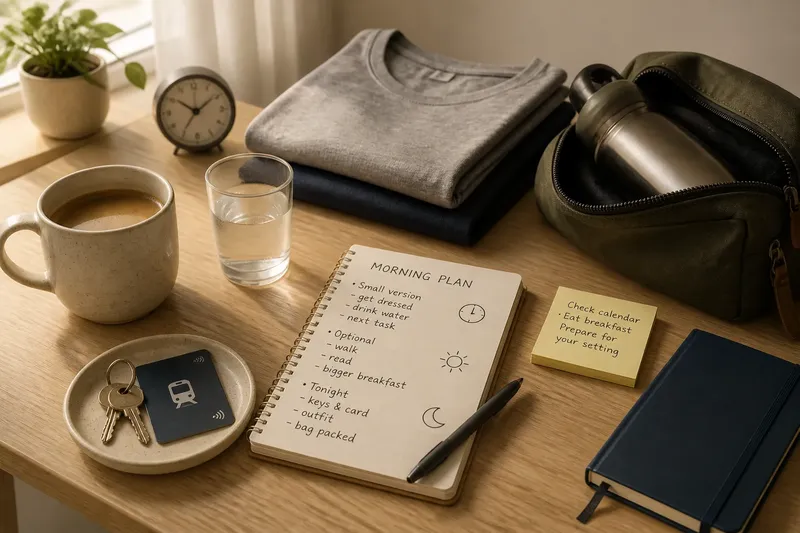
An object-based cue is something you handle or see: your keys, a water bottle, a laundry basket, or a notebook. It can suit a routine when the object is already part of the action and stays visible where you need it.
For instance, placing a reusable bag beside your keys can remind you to take it when leaving. But an object hidden in a drawer may be a poor cue, and a shared object may be moved. Pick something you naturally encounter, rather than adding another item that needs managing.
How do you choose a cue that fits?
Start with the action, not the cue. Name the smallest useful beginning: open the document, place the shoes by the door, or write one line in a notebook. Then ask what happens immediately beforehand on an ordinary day. A cue should connect to the action without requiring you to rearrange the day around it.
- Check how often the moment occurs. If it happens only on occasional days, decide whether that is enough for the routine you want.
- Check whether you notice it. A quiet event you routinely miss may be weaker than a visible or physical transition.
- Check what happens next. Avoid a cue that is usually followed by an interruption or a rush.
- Check the action’s location. If it needs a particular room or object, make sure the cue and materials meet there.
- Check the effort of the start. If the first action needs several decisions or supplies, simplify the beginning.
- Check whether the cue is yours to use. A moment controlled by another person or a shared object that often moves may not be dependable.
Use the answers to choose one cue, not a chain of reminders. If two options seem equally suitable, try the one that already occurs closest to the action. The fewer extra decisions between cue and start, the easier the link is to remember.
What if your day does not follow a steady pattern?
A cue does not have to arrive at the same clock time. Look for a repeated event instead: finishing a meal, plugging in your phone, or returning home. The event may move around while its meaning stays recognizable. That makes cue-based routines useful for days with changing shifts, errands, or family plans.
Say you want to practice a language but your evenings vary. You could connect opening your laptop to listening to one short lesson before starting leisure browsing. The concrete starting point is an existing action—opening the laptop—followed by a bounded next action. The observable result to look for is whether the lesson gets opened at that transition, not whether you complete a long study session every day.
If the laptop sometimes opens for urgent work, that may be the wrong cue. Choose a different transition, such as putting away your dinner dishes, or make the action small enough to fit before the competing task. If the cue disappears for a while, resume when it returns; there is no need to treat a missed occasion as a reason to rebuild the whole routine.
What should you do when the cue stops working?
First identify where the link breaks. You may not notice the cue, may notice it but lack the materials, or may reach the moment when another demand takes over. Those are different problems, and a larger routine is unlikely to solve any of them by itself.
If you miss the cue, make it more visible or choose a clearer event. If you notice it but cannot start, reduce the first action or prepare what it needs in advance. If the cue repeatedly coincides with a rush, use a calmer transition. Change one part at a time so you can tell whether the new arrangement fits better.
Keep the action flexible enough to handle ordinary interruptions. A cue can mean “begin if this moment is available,” rather than “drop everything.” For a routine involving another person, agree on a cue that does not depend on guessing their schedule. The point is to make your own start easier to recognize, not to turn a reminder into a demand on someone else.
Which cue questions are worth asking?
Can I use more than one cue?
You can, but begin with one clear link so you know what to notice. Add another cue only if the routine has genuinely different settings, such as working at home on some days and elsewhere on others.
Does the cue need to happen at the same time each day?
No. A repeated event can serve as the cue even when its clock time changes. Look for a recognizable transition, and avoid relying on an event that often disappears from your day.
What if I miss the cue?
Let the missed moment pass and use the next natural opportunity. If you often miss it, adjust the cue or make it easier to notice rather than adding blame or a complicated catch-up plan.
How small should the linked action be?
Small enough that you can picture its first move clearly. Opening a notebook is easier to begin than “work on a project,” and you can decide what comes after you have started.
How can you tell whether the cue is a good fit?
For a short stretch of ordinary days, notice whether the cue appears and whether the action begins after it. You do not need a tracking system; a brief mental check or a note on scrap paper can reveal the pattern. If the cue is present but the action rarely follows, look at the action’s effort and the moment’s demands before replacing the whole idea.
Choose a moment-based cue when transitions are steady, a place-based cue when the action belongs in a reliable spot, or an object-based cue when a useful item is already in view. The best familiar cue is the one that fits the life you have, not an idealized schedule. Keep the pairing plain, let it change when your circumstances change, and make the next action small enough to begin.